
Exploding Black Holes, Coral Rocks on Mars & Shooting Stars: Amazing Space Adventures!

🌠 Every summer, the Perseid meteor shower lights up the night sky with bright, fast "shooting stars."
☄️ Meteors are tiny bits of dust and rock from comets that burn up when they enter Earth's atmosphere, making glowing streaks.
✨ The Perseids are named after the Perseus constellation and come from debris left by Comet Swift Tuttle.
🔥 At their peak, you can see up to 100 meteors an hour, and sometimes huge "fireballs" brighter than planets!
🌌 In 2025, the best time to watch is August 12–13, far from city lights, after your eyes adjust to the dark.


KIDS SCIENCE MAGAZINE - 04.08.25
🌠 The Planet That’s Falling Into Its Star! This Giant Planet Is Spiraling Into Its Star—What Happens Next Will Blow Your Mind!
Hey space fans! 🚀Have you ever seen something so big, so fast, and so doomed it sounds like a cosmic drama? Meet TOI-2109b, a planet way bigger than Jupiter that’s speeding toward its star like a space rollercoaster on fire! 🎢🔥
🌍 A giant planet almost twice the size of Jupiter, super heavy, and zooming around its star in just 16 hours!
⏳ It's Falling In!; The planet's orbit is shrinking, and it's getting pulled closer and closer to its star every time it goes around.
🔥 Three Scary Endings; It could crash into its star, get its gas ripped away, or be torn apart by gravity.
🧠 Studying this planet helps scientists learn how planets change, die, and maybe even how rocky planets are made.
💡It's so hot there (up to 3,500°C) that it's hotter than some stars, and you could have two birthdays in one Earth day!
Uranus’ New Moon, Mysterious Space Rocks, and the Secrets of the Universe!

🌍 Uranus is a giant planet far away in space, and it spins on its side, which makes it very different from Earth.
🚀 Only one spacecraft (Voyager 2) has visited Uranus, and that was almost 40 years ago!
🔥 Scientists just found out Uranus might be warmer than they thought because it makes more heat than it gets from the Sun.
💡 Uranus shines back lots of sunlight, and it gives off about 15% more energy than it receives, which surprised everyone.
🔭 Learning about Uranus can help scientists understand other planets far away from our solar system.

🌕 Scientists using the James Webb Space Telescope discovered a new moon around Uranus, the 29th moon!
🔭 The moon is called S/2025 U1 for now and is about 10 km wide so small that even Voyager 2 missed it.
📷 The telescope found it by taking 40-minute-long photos, which revealed this very faint moon.
📚 The moon will get a real name later, just like Uranus' other moons named after Shakespeare and Pope's characters, such as Desdemona and Ophelia.
❄️ Uranus is a cold, windy ice giant that looks blue because of methane in its atmosphere, and this discovery helps scientists learn more about.

🌕 A super rare rock from Mars was sold at an auction for $4.3 million that’s a lot of money!
🪨 The rock is called NWA 16788, and it was found in Niger, Africa, in 2023. It’s really big for a space rock about 54 pounds and nearly 15 inches long!
☄️ A meteorite is a space rock that survives its fall through Earth’s atmosphere and lands here.
🌍 Only about 400 rocks from Mars have ever been found on Earth that makes this one extra special! Nobody knows who bought the rock the new owner is keeping it a secret!
🌊 Most of Earth is water, so it’s super lucky that this rock landed where people could find it! Scientists say it’s the biggest piece of Mars on Earth pretty amazing, right?


🌟 Sometimes space rocks come from far, far away! These are called interstellar objects, and they zoom into our solar system for a short visit before flying back.
🔭 A new super telescope called Vera Rubin will watch the sky and could find lots more of these visiting space rocks, maybe 5 to 100 of them in the next 10 years.
🚀 Scientists are curious if these space rocks are just rocks or maybe alien things. Some people think one of them, might have been a piece of alien tech!
🪐 Studying these visitors helps us learn how planets and stars are made and where these rocks come from in the galaxy.
👽 By finding more of them, we might even answer a big question: Are we alone in the universe, or are there aliens?
Shooting Stars, Baby Planets & Space Snacks: Your Guide to the Wonders of the Sky!

🌠 The Delta Aquariid meteor shower is coming, and you can see it in the sky between July 12 and August 23. On July 30, you might see up to 25 shooting stars every hour!
🌌 These meteors are tiny space rocks that burn in the sky and look like streaks of light. They come from a comet called 96P/ Machholz, which leaves a trail of dust as it flies near the Sun.
🔭 You don’t need a telescope just your eyes! Go outside, look up, and let your eyes get used to the dark for 20 minutes before watching.
🏕️ Try to watch from a dark place away from city lights. Bring a blanket or a chair so you can lie back and watch comfortably.
✨ It’s like a space light show, and you’re seeing real pieces of a comet flying through Earth’s sky. So enjoy the magic of space!

🌟 Scientists saw a baby star starting to make planets! They spotted the very beginning of a new solar system far, far away in space.
🔭 The star is called HOPS-315. It’s like a baby version of our Sun and lives 1,300 light years away in a place called the Orion Nebula.
🪐 They saw tiny bits of rock forming planets. These little specks are super hot and are just starting to become solid.
🛰️ Big space telescopes helped find it. They used the James Webb Space Telescope & another big one in Chile called ALMA.
🌌 This helps us learn how our own solar system was born. It’s like looking back in time to see how Earth and the other planets started to form!
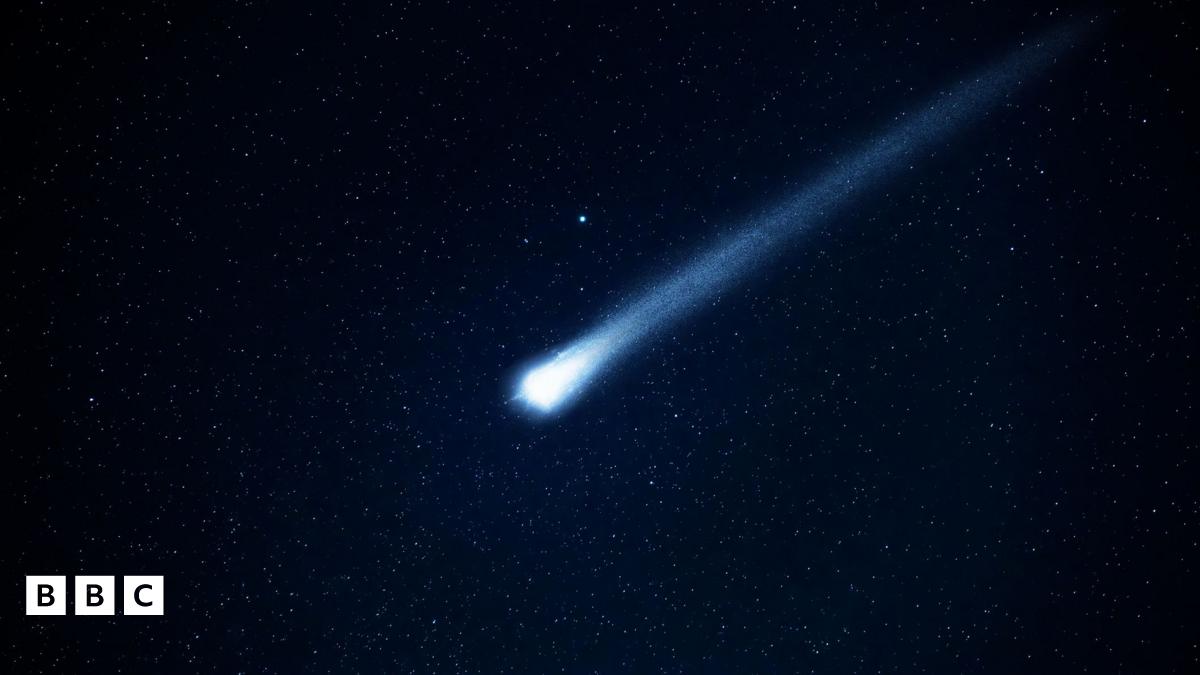
🌠 Astronomers found a super fast space object called 3l/ATLAS zooming through our Solar System!
🧊 It’s a big icy comet like a giant space snowball that’s about 6 to 12 miles long!
🚀 It’s not from our Solar System it came from far, far away and is only the third visitor like this we’ve ever seen.
🌞 3l/ATLAS will fly past Mars and the Sun, but don’t worry it won’t come close to Earth!
🔭 Scientists are excited because studying this comet might teach us more about life deep in space!


BBC Newsround - 4.07.25
First Michelin-starred gourmet meal to be served in space in 2026
French astronaut Sophie Adenot has teamed up with a top chef to come up with a list of very fancy starters, mains and desserts to look forward to on her mission on the International Space Station. So we want to know what delicious treats you'd dine on in space - let us know!
🍲 Astronaut Sophie is going to space with fancy food! Instead of boring space meals, she’s bringing yummy dishes made by a famous chef.
🧑🚀She’ll eat things like lobster soup & chocolate cream! That’s way fancier than freeze dried space food, right?
🍽️ Space food has to follow special rules. It can’t be messy, heavy, or go bad quickly, it has to last for long!
🫶 Sophie says sharing food helps astronauts become better friends. Everyone gets to taste each other’s favourite meals and learn about their cultures.
❓ What meal would YOU choose to eat in space? A cheesy pizza? Pancakes? Ice cream? Let your imagination blast off! 🚀